
SCOTUS Watch

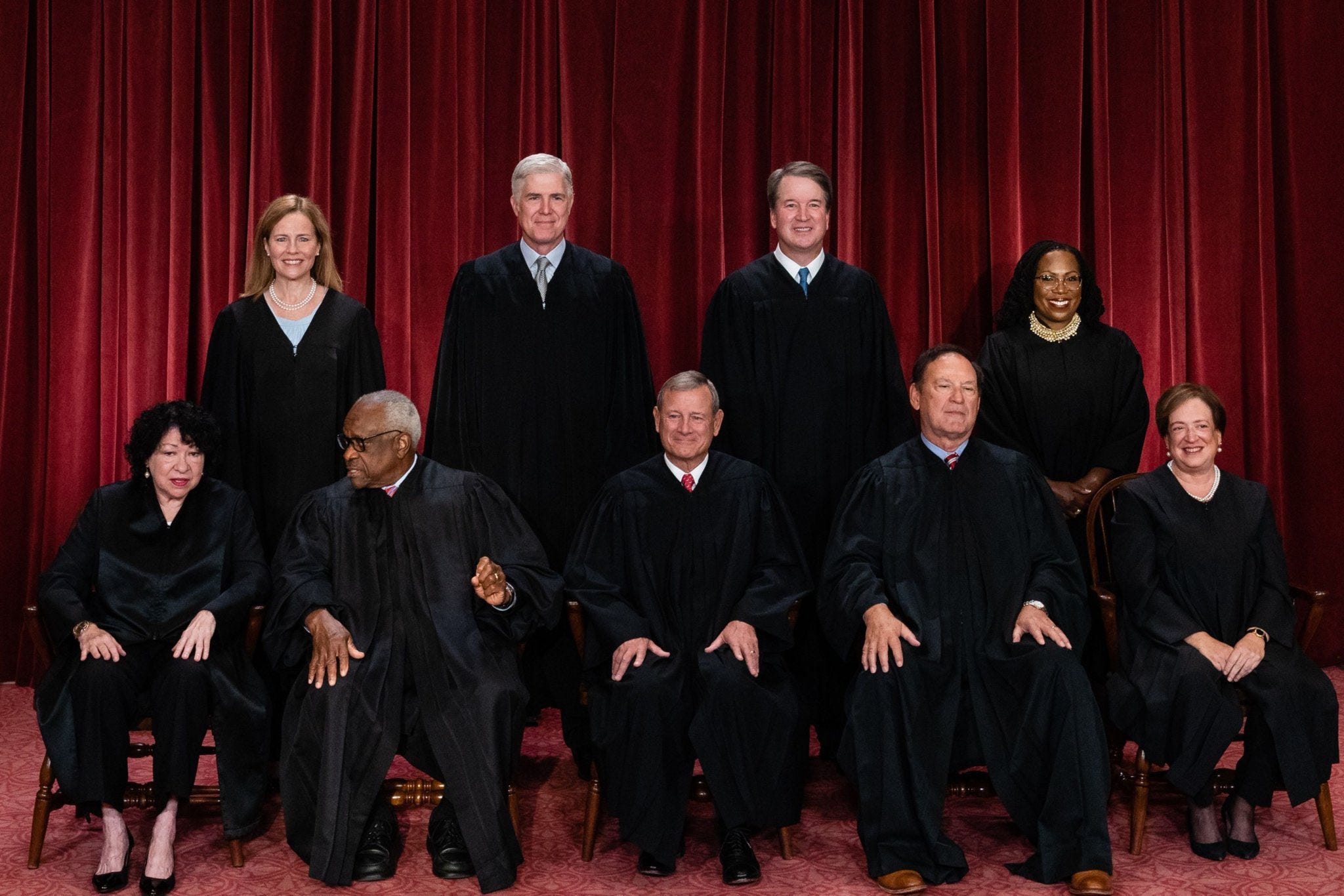
Order List
The Supreme Court accepted a case for review regarding compassionate release.
Otherwise, Monday’s Order List was notable for dissents regarding two cases they did not grant for review. The rest was the usual mundane housekeeping stuff.
Native Americans
They did not grant cert (full review) to two cases, which they have been “relisting” (re-examining in conference). One involved a religious liberty case involving Native Americans, the other an anti-trans t-shirt in middle school.
Justice Alito (probably for financial reasons, but the conservatives don’t explain why they recuse) did not take part in the first case. Gorsuch, who rarely finds a Native American claim he rejects (ditto a free exercise one, at least the cases likely to be taken by this Court), wrote the dissent, joined by Justice Thomas.
Both the Biden and Trump Administrations opposed taking the case. Maggie Blackhawk (federal Indian law scholar) on Bluesky said it was "complicated and controversial" and noted it was a religious liberty case, not one about tribal power. She argues tribal decision-making should be the focus here.
Gorsuch saw it as a grievous wrong not to take the case, tossing in claims of not respecting minority religions. The case involved control of federal lands, sacred sites, and mining. The closely divided lower court split on whether a 1980s case was appropriate when applying the Religious Freedom Restoration Act.
I’m okay with keeping SCOTUS from taking a religious accommodation case. Don’t trust their judgment. Plus, two administrations arguing it is not a good vehicle, along with an Indian law scholar noting it is “complicated.”
The case might have been a good one to take to settle the question. Nonetheless, two sets of justices on opposite sides of the ideological divide said “no.” That’s okay.
“There Are Only Two Genders”
Alito (again with Thomas joining) became Justice Free Speech when an anti-trans t-shirt in a middle school was involved. Thomas was particularly hypocritical given his past arguments that school children don’t have First Amendment rights.
[ETA: Okay, to be fair, Thomas did acknowledge his past opinions. He said that the issue here is that the lower court did not properly apply Tinker. I still am not convinced. He has not been consistently concerned about lower courts following precedent. Thomas picking this specific spot is a bit too convenient.]
The case involved applying Tinker, the famous armbands case, which over time has been somewhat narrowly applied. We had decades of these t-shirt regulation cases. The school argued that the ban was necessary to protect LGBTQ people.
As we have discussed, the record does not demonstrate any facts which might reasonably have led school authorities to forecast substantial disruption of or material interference with school activities, and no disturbances or disorders on the school premises in fact occurred.
The school argues, contrary to Tinker, that the record does provide evidence that wearing shirts with these messages will cause serious disruption and/or material inference. The Supreme Court has allowed more discretion to schools, including in cases involving student elections (sexual metaphors), student newspapers (pregnancy), and silly marijuana signs (Alito went along there).
A case involving off-campus speech (the cursing cheerleader) is not quite on point. Sounds like the right call. Gay USA hosts were somewhat split about the case this week, consistent about free speech. I can see some close calls with t-shirt messages.
Still, the Supreme Court was probably correct not to intervene in the school’s decision-making here. Possibly demeaning and hurtful messages will cause problems with fellow students. The student was not stopped from merely expressing a viewpoint. A walking message board is a harder call.
Tinker’s armband was not an attack on any group except for those supporting a war in Washington, D.C. Military families weren’t the target. A t-shirt expressing a view about soldiers might be somewhat different.
Again, if a school allowed the t-shirt, I could also see a case. The test is “reasonableness.” So, schools can disagree on the issue. Good avoidance vote.
Opinion Day
Holding: The D. C. Circuit failed to afford the U.S. Surface Transportation Board the substantial judicial deference required in National Environmental Policy Act cases and incorrectly interpreted NEPA to require the Board to consider the environmental effects of upstream and downstream projects that are separate in time or place from the Uinta Basin Railway.
The one opinion was unanimous (Gorsuch not taking part), though the liberals (via Sotomayor, concurring) and conservatives (via Kavanaugh writing for the majority) disagreed on details. It limited the reach of environmental impact statements.
Sotomayor agreed that the lower court was wrong to second-guess the agency and require something more. She, however, argued the majority rested too much on “policy,” perhaps concerned about the future. Jackson didn’t write a separate opinion, but the concurrence followed her “just following the law here” rallying cry.
The majority furthered its policy of second-guessing agencies, at least when they disagreed with the results, and the concurrence kept that in mind as well.
Other Orders
Alito provided an administrative stay (temporary hold) in response to a request involving bankruptcy. More importantly, we have another pro-Trump stay.
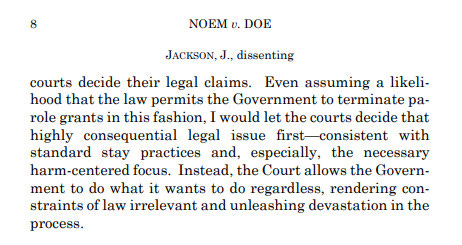
To quote one article: “The Supreme Court allowed the Trump administration to revoke temporary legal status granted to more than 500,000 immigrants by the Biden administration. The policy, known as the CHNV parole programs, allowed people who passed a security check and who had a sponsor in the United States who could provide housing, to enter the country and stay.”
Chris Geidner and Amy Howe have more. Jackson (with Sotomayor) provided a strong public dissent, both addressing the problems with the procedure (interfering with a developing case without saying why) and on the merits.
[One liberal commentator argues that Trump has a good case on the merits. IDK, but not really sure Jackson doesn’t imply anything in that respect. And, some other observers did not provide such a negative view of the merits.]
Kagan, for whatever reason, did not make her opinions known. She did not formally “agree” with the Court, which acted anonymously. Nonetheless, silence usually means consent, even if she did so here for strategic reasons.
The Administration is not just going after “illegals.”
Upcoming
There will also be an Opinion Day next Thursday, which will begin the June final stretch involving handing down around a third of the term’s opinions.
More orders will come on Monday. We are done with oral arguments, though with Trump alone, there is always a chance for something notable to happen off schedule.
Meanwhile, Trump is starting to nominate judges, including at least one really horrible option (Emil Bove). The fact that he might be replacing the person who should have been the first Muslim court of appeals judge (there are two vacancies there now, so maybe not) just adds insult to injury.
Then, we have just run-of-the-mill Trump ideological picks. Ugh.