
Texas Biblical Reading List

The Republican-controlled board voted 9-5 with one member absent to adopt the reading lists, which were required under a 2023 state law directing the board to specify required vocabulary and at least one literary work for each grade level. The adopted lists contain nearly 200 literary works spanning kindergarten through high school, including selections from the Bible alongside classic works by authors such as William Shakespeare, Jane Austen, Charles Dickens, and E.B. White.
The requirements will take effect beginning with the 2030-2031 school year....
The reading lists assign different Bible passages from specific translations, including the New International Reader’s Version, King James Version, and English Standard Version.
It’s a bit soon to worry about something that will take effect in the middle of the new presidential term. Still, this is getting some attention.
Some time back, Texas's choices in this general area received attention because its textbook market has national effects. Texas is the second most populous state in the United States. Textbook providers will place special concern on their choices.
The book list makes Texas the only state in the country to issue its own literature requirements, rather than leaving the choices up to teachers or districts.
The list is not only biblical. This is part of a wider attempt by the state, as has been done in Florida, to direct what is taught in school. The statewide character is notable, but school boards often do this locally. Thus, the importance of who staffs them.
In addition, it might well be said that one's education is not complete without a study of comparative religion or the history of religion and its relationship to the advancement of civilization. It certainly may be said that the Bible is worthy of study for its literary and historic qualities.
Nothing we have said here indicates that such study of the Bible or of religion, when presented objectively as part of a secular program of education, may not be effected consistently with the First Amendment.
But the exercises here do not fall into those categories. They are religious exercises, required by the States in violation of the command of the First Amendment that the Government maintain strict neutrality, neither aiding nor opposing religion.
The Supreme Court banned required Bible readings deemed to have a forbidden religious educational character. All types of biblical instruction are not banned.
Some people might want to totally avoid this sort of thing, but that is going too far. I went to a Catholic high school. We had a class covering Islam. Our teacher, now this might not work these days, even had us proclaim the statement of faith.
Nonethless, this appears to be a particular favoring of the Bible. Any religious-related education in public schools requires a certain finesse. There are lots of religions. Why should the Bible have such special respect K-12? The choices alone are tricky.
The first link provides a summary of what is required. For instance:
1st Grade- Jonah and the Whale by Jonah 1:1-5, 10-17, 2:10; 2nd Grade- David and Goliath (excerpt from The Children’s Book of Heroes) by William J. Bennett (editor); 3rd Grade- ROAR! – Daniel and the Lion’s Den – Children’s Adapted Version by CBN.
These are understandable choices for children. I do prefer a different Davey and Goliath, though it might also reflect my age.
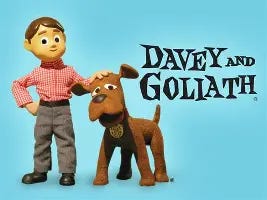
I wonder what lessons will be taught with these stories. William J. Bennett? Remember that guy? The conservative values guy.
Thomas Jefferson once argued that children should not receive religious instruction until they have a firm basis of secular knowledge. They then would have the skills necessary to contemplate religious works.
The options for young children are not just childish stories. Jonah and the Whale is an ironic account of an anti-hero tasked to warn an enemy to repent. Daniel, an anachronistic figure (the book was written hundreds of years after the supposed historical context), also has some important context. A story about a young boy killing someone (it isn’t even clear if David actually killed Goliath; there are multiple accounts with a different person involved in some of them) is a questionable choice.
The opening video is an FFRF rejection of the Ten Commandments. We shall see if Stone v. Graham remains good law. Either way, we should do more than display them as a sort of graven image. We should think about and examine them.
I think doing so will lead to complicated results. The Ten Commandments, on some level, are a somewhat limited summary of basic values. For instance, positive obligations, including caring for others, are a basic principle of most religions.
They still have value, especially if we look at the spirit of the commandments, and apply them in a way respecting public values. So, yes, the added commentary found in the Bible about damning the children of lawbreakers (a sort of “corruption of blood”) is misguided. We are not stuck with all the baggage, including sexist, involved.
It is also one thing to have some respect for the Ten Commandments as compared to mandating that they be hung up in schools. But if we are stuck with them in schools, there is also an obligation to talk about them. The same would be true with anything posted in schools. Or said, including the Pledge of Allegiance.
[I talk about the Pledge here.]
Schools, in some sense, indoctrinate. That sounds like a nasty word on some level. We can cushion the blow by carefully teaching while honoring free thought.
Reading assignments will include some religious content. We should cover all religions. This should not just be a backhanded way to use the public schools to provide CCD instruction. Something to think about until 2030 comes around.